Educational Games
Add some fun to your homeschool learning with these exciting and educational online games.
Educational Games
Fun Brain
Fun Brain has educational online games for kids, along with resources for parents and teachers. Subjects covered include: art, geography, history, languages, math, music, science, technology, and more
Virtual Manipulatives for Interactive Mathematics
This website features online games and interactive activities designed to help children learn and understand mathematical concepts. You can choose any grade level from pre-K to 12, and subjects including numbers and operations, algebra, geometry, measurements, data analysis, and probability. You'll find virtual peg boards, geoboards, fractals, charts, games, and much more.

Name That Country Game
"Dear Pen Pal, Konnichi wa! We've been to see Mt. Fuji. Name my country! Sayonara, Michiko." Challenge your group with this fast-paced geography game, created in 1992 by Educational Insights, Inc. Everyone begins at the post office. Players twirl a finely printed spinner (built into the game board itself) to select one of 60 countries. If the player can correctly identify the country's location on the board's numbered map, he or she may advance along the path to the finish. Bonus moves are won by landing on "postcard" spaces, listening to the clues on one of the 40 postcards, and correctly identifying the pen pal's country. (The sample postcard above came from Japan.) A more challenging game can be achieved by requiring players to name the country's capital; answers are provided. --Liane Thomas

Great States Board Game
What is the capital of NJ? Where is the Football Hall of Fame? These are just a few of the hundreds of questions players are asked as they adventure around the USA discovering state attractions and landmarks, capitals, state abbreviations, state locations and more. In order to answer the questions on the cards, players must look closely at the colorful USA map game board, becoming familiar with the geography of the country. Players must hurry to find the answers as the mechanical timer ticks. Contents: Game board, 100 Figure cards, 100 Fact cards, 100 Find cards, 1 spinner, 1 mechanical timer, and game rules. Duration of Play: 20 minutes. 2-6 players.
Looking for Another State?
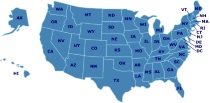
Featured Resources
As an Amazon Associate, we earn from qualifying purchases. We get commissions for purchases made through links on this site.

Creative Home Schooling: A Resource Guide for Smart Families
For a comprehensive guide to home-based education, that does not promote any particular curriculum or religious view, this is one book parents should buy! Parents will appreciate practical advice on getting started, adjusting to new roles, designing curriculum that is both child-centered and fun, and planning for social and emotional growth. Parents will turn to their favorite chapters again and again. Features interviews and tips from many homeschool parents as well as long lists of resources...

Catholic Home Schooling: A Handbook for Parents
Mary Kay Clark, the director of the accredited and successful Seton Home Study School shows parents why and how to teach their children at home, giving scores of practical examples and setting forth the spiritual, moral and academic advantages. The book includes chapters by several experts and covers Catholic curriculum, textbooks, Catholic family life, legal aspects, discipline, socialization, home management, using computers, children with learning disabilities, single-parent home schooling, t...

They're Your Kids: An Inspirational Journey from Self-Doubter to Home School Advocate
For many people, their schooling was uncomfortable, tedious, and sometimes a waste of time and energy. This book offers the idea that the public school system is tragically flawed and that we are able to do better for our own children. Sam Sorbo, mom of three and wife of actor Kevin Sorbo, took the leap into homeschooling and found the joy and success she was seeking. Included are strategies for working parents, those who are scared to take the leap, and anyone who wants the best for their child...

Morning by Morning : How We Home-Schooled Our African-American Sons to the Ivy League
Home schooling has long been regarded as a last resort, particularly by African-American families. But in this inspirational and practical memoir, Paula Penn-Nabrit shares her intimate experiences of home-schooling her three sons, Charles, Damon, and Evan. Paula and her husband, C. Madison, decided to home-school their children after racial incidents at public and private schools led them to the conclusion that the traditional educational system would be damaging to their sons’ self-esteem...

A Little Way of Homeschooling
This book is a compilation of the experiences of 13 different homeschoolers and how they incorporated an unschooling style of teaching in their homes. This book addresses the question of whether a Catholic can happily and successfully unschool. This home education approach is presented as a sensible way to access the mystery of learning, in which it operates not as an ideology in competition with the Catholic faith, but rather a flexible and individual homeschooling path.